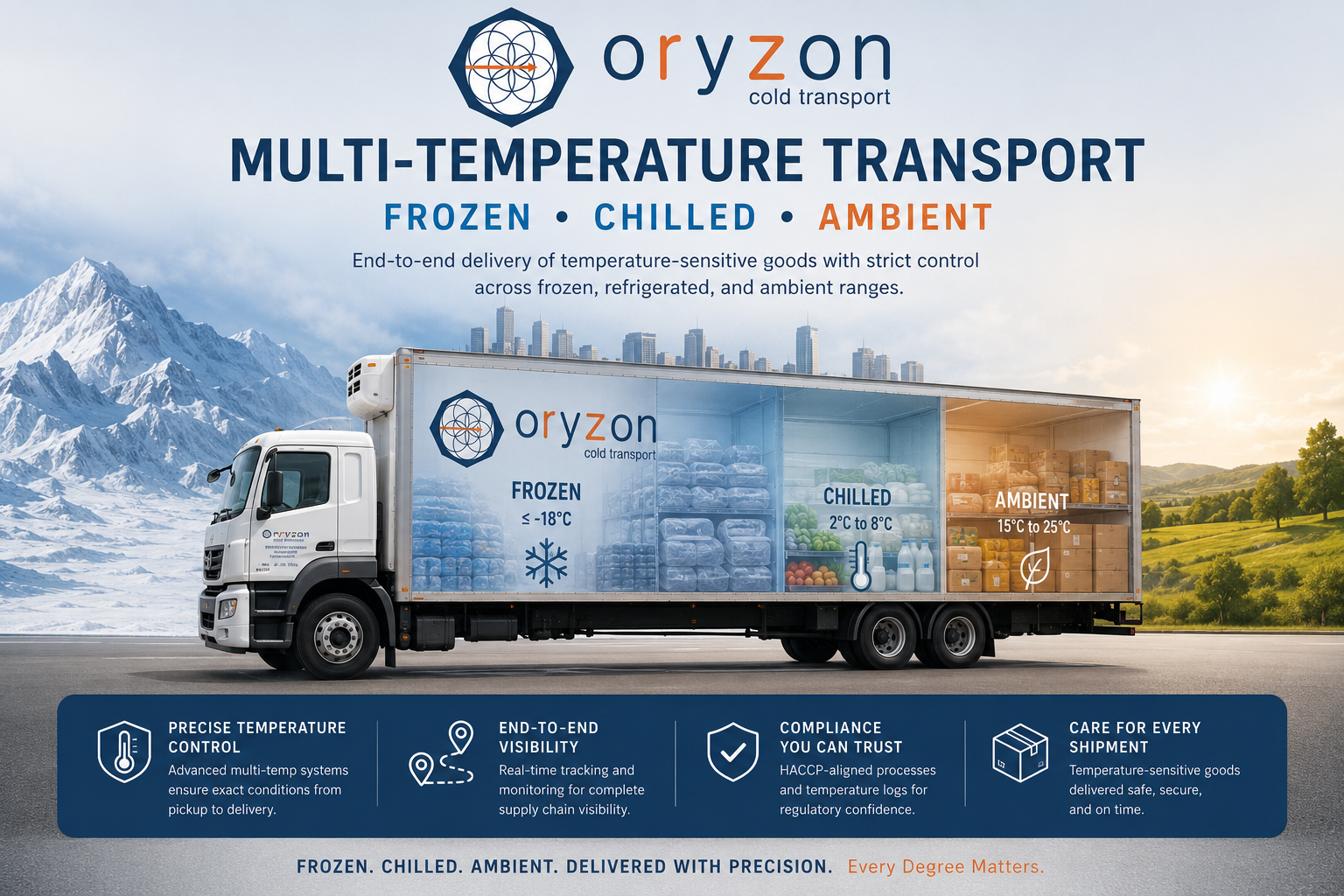
Running a refrigerated carrier in 2026 means operating at the intersection of federal compliance, customer expectations for real-time visibility, and the constant pressure to keep operating costs in check. The tools you choose — for dispatch, ELD compliance, cold chain temperature monitoring, fuel management, and accounting — have a real impact on whether you run a tight, professional operation or spend your days chasing paper.
We built Oryzon Cold Transport from scratch in the Houston market, and we went through the process of evaluating every major platform in each category. This article covers what we found — the pros, the cons, and who each tool is actually built for.
Disclosure: Some links in this article are affiliate links. If you use them to sign up, we may earn a commission at no additional cost to you. We only recommend tools we have personally evaluated.
In This Article
ELD & Fleet Telematics
ELD compliance isn't optional — every commercial motor vehicle over 26,000 lbs operating interstate is required to have an Electronic Logging Device under the FMCSA mandate. But ELD is really a floor, not a ceiling. The best telematics platforms do far more: GPS tracking, driver behavior monitoring, DVIR inspections, IFTA reporting, and in some cases, live video dashcams. For a cold chain carrier, real-time vehicle location is also the backbone of the customer visibility experience.
We evaluated four major platforms: Samsara, Motive, Geotab, and Verizon Connect.
Samsara
Samsara is arguably the most polished fleet platform on the market today. The hardware is sleek, the mobile app is excellent, and the real-time map view is genuinely impressive. If you want dashcam footage that uploads automatically when a safety event occurs, Samsara's AI dash cam is best in class. Shippers and brokers are increasingly recognizing the Samsara name, which gives it a mild credibility edge.
✓ Pros
- Best-in-class AI dashcams
- Clean, intuitive interface
- Strong IFTA & HOS reporting
- Excellent real-time GPS
- Good customer support
✗ Cons
- Premium pricing — higher per-unit cost
- Annual contracts typically required
- Can be overkill for 1–5 truck ops
- Hardware cost adds up
Best for: Growing fleets (5+ trucks) that want a premium, all-in-one platform and have the budget for it. The dashcam alone can be worth the price if you're hauling high-value cold chain freight.
Try Samsara →Motive (formerly KeepTruckin)
Motive built its reputation in the owner-operator and small fleet market, and it still shines there. The ELD hardware is reliable, the app is straightforward, and the pricing is meaningfully more accessible than Samsara for a small operation. Motive has been expanding its platform aggressively — adding AI dashcams, a fleet card, and dispatch tools — making it a legitimate all-in-one contender. For a 1–10 truck cold chain operation, Motive is often the most practical choice.
✓ Pros
- Competitive pricing for small fleets
- Trusted ELD — widely accepted
- Good driver app & HOS logging
- Expanding into AI dashcams & dispatch
- Strong owner-operator community
✗ Cons
- Customer support can be slow
- Interface less polished than Samsara
- Some advanced features require upgrades
- Dashcam quality trails Samsara slightly
Best for: Owner-operators and small fleets (1–10 trucks) who want solid ELD compliance and reliable GPS at a fair price. Our top pick for carriers just getting started.
Try Motive →Geotab
Geotab is the enterprise-grade telematics platform used by some of the largest fleets in North America. It's extremely powerful and highly customizable — if you want to build custom reports, integrate with third-party software, or manage a mixed fleet across multiple regions, Geotab can do things the other platforms can't. The downside for small carriers is that Geotab is sold through resellers and requires more setup and configuration than a plug-and-play solution like Samsara or Motive.
✓ Pros
- Extremely powerful & customizable
- Best-in-class data & reporting depth
- Large ecosystem of add-on integrations
- Excellent for mixed or specialized fleets
✗ Cons
- Sold through resellers — pricing varies
- Steeper learning curve
- Overkill for small fleets
- Setup requires more time & expertise
Best for: Mid-to-large fleets (20+ trucks) with dedicated fleet managers, or operations that need deep customization and third-party integrations. Not our first recommendation for a small reefer operation.
Learn About Geotab →Verizon Connect
Verizon Connect brings the weight of the Verizon brand and a broad product suite to fleet telematics. The platform covers GPS tracking, ELD compliance, dashcams, and routing — and for carriers who already operate within the Verizon wireless ecosystem, there can be integration advantages. The sales and onboarding experience is more enterprise-oriented, which can feel slow for small operators who just want to get a truck on the road with ELD.
✓ Pros
- Trusted enterprise brand
- Full suite: ELD, GPS, dashcam, routing
- Strong network reliability (Verizon LTE)
- Good option for larger operations
✗ Cons
- Enterprise-focused sales process
- Higher price point
- Less startup-friendly onboarding
- Contract terms can be inflexible
Best for: Established carriers or fleets already in the Verizon ecosystem who want a single vendor relationship for connectivity and telematics. Not the fastest path for a new small carrier.
Learn About Verizon Connect →Temperature Monitoring
This is where cold chain logistics carriers are genuinely differentiated from generic carriers who "run reefers." Any truck can have a reefer unit. Not every carrier can prove — with timestamped, tamper-evident data — that your product stayed within range from dock to dock. Temperature monitoring technology is what makes that possible, and increasingly, it's what food, pharma, and perishable shippers are demanding before they'll hand you a load.
We evaluated two strong options at different price points and use cases: Tive and Monnit.
Tive
Tive makes cellular-connected, shipment-level trackers — small devices that ride inside the load itself and transmit real-time temperature, humidity, light, and shock data via 4G LTE. The cloud platform gives you and your customers a live view of every shipment's condition, and you can set automated alerts for excursions before they become rejected loads. For perishable food, pharmaceutical, and floral shippers, Tive provides the visibility layer that justifies a premium service level.
✓ Pros
- Real-time cellular transmission (no gateway needed)
- Tracks temp, humidity, light, shock & tilt
- Automatic alerts on excursions
- Customer-facing visibility portal
- Excellent for pharma & premium food freight
✗ Cons
- Per-shipment or subscription cost
- Overkill for standard dry/ambient loads
- Trackers must be returned or are disposable
Best for: Carriers who want to offer shipment-level temperature visibility to customers — especially for pharmaceuticals, specialty produce, floral, and any freight where proof-of-condition matters at delivery. A real competitive differentiator.
Explore Tive →Monnit
Monnit takes a different approach. Rather than shipment-level trackers, Monnit specializes in wireless IoT sensors that mount inside your trailer, walk-in cooler, or warehouse and transmit data continuously via a cellular or Wi-Fi gateway. For carriers who want to monitor their equipment — making sure a reefer unit is actually holding temperature before the driver leaves the yard — Monnit's trailer sensors are a cost-effective and reliable option. The sensor library is huge: temperature, humidity, door open/close, power status, and more.
✓ Pros
- 80+ sensor types — very versatile
- Lower per-unit hardware cost than Tive
- Great for permanent trailer monitoring
- Wireless, long battery life (10+ years)
- Good for warehouse & facility monitoring too
✗ Cons
- Requires a gateway device in each trailer
- Not shipment-specific (vehicle-level, not load-level)
- Platform less polished than Tive's shipper portal
Best for: Carriers who want to monitor trailer conditions continuously, verify reefer unit performance, and build FSMA-compliant temperature records — at a lower cost per sensor than shipment-level trackers.
Explore Monnit →Fuel Card
Fuel is the single largest variable cost for any trucking operation. A refrigerated carrier runs the reefer unit on top of the truck's fuel consumption, which means your fuel bill is consistently higher than a dry van operator running the same miles. A fuel card that actually delivers at-the-pump savings — not just a credit card with a trucking logo — can make a meaningful difference over the course of a year.
AtoB Fuel Card
AtoB is a newer fuel card built specifically for trucking companies, and it stands out because the discounts are real and the application process is genuinely accessible for new carriers. Unlike some legacy fuel cards that require established credit history or minimum fleet sizes, AtoB is designed to work with small operators. Average savings of 46¢/gallon — and up to $1.85/gallon at partner stations — add up fast on a reefer operation. The card is Mastercard-accepted everywhere, not just at certain truck stops.
✓ Pros
- Average 46¢/gal savings, up to $1.85/gal
- Accepted nationwide (Mastercard network)
- Accessible for new & small carriers
- Spending controls & real-time alerts
- No hidden fees model
✗ Cons
- Newer company — less history than WEX/Comdata
- Discount varies by station & region
- Credit approval still required
Best for: Small and growing carriers who want real fuel discounts without the friction of legacy fleet card programs. The $250 welcome bonus for new accounts makes it worth applying early.
Apply for AtoB →Accounting
A lot of small carriers run their books out of spreadsheets or a shoe box of receipts. That works until it doesn't — and when it stops working, it usually stops at the worst possible time (tax season, a loan application, or an FMCSA audit). Getting your accounting right from day one matters, and for a small trucking operation, the right tool is almost always QuickBooks.
QuickBooks Online
QuickBooks Online is the de facto standard for small business accounting in the US, and trucking is no exception. It integrates with virtually every other platform you'll use — your bank, your fuel card, your payroll provider — and it gives you profit & loss, cash flow, and expense tracking in a way that your CPA will actually recognize when tax time comes. For IFTA fuel tax reporting, mileage tracking, and driver pay calculations, QuickBooks pairs well with trucking-specific mileage apps. It's not trucking-specific software, but the breadth of integrations makes it the most practical choice for a small operation.
✓ Pros
- Universal — your CPA knows it
- Integrates with virtually everything
- Strong invoicing & expense tracking
- Mobile app for on-the-go receipts
- Scalable as your operation grows
✗ Cons
- Not trucking-specific (no load management)
- Monthly subscription cost adds up
- IFTA requires separate mileage tracking
- Learning curve for first-time users
Best for: Any small carrier who wants clean books, easy invoicing, and a financial picture that works at tax time and with lenders. Pair it with a mileage tracking app for IFTA and you have a solid accounting foundation.
Try QuickBooks Online →Our Picks at a Glance
If you're a small cold chain carrier — 1 to 10 trucks, operating in the Gulf Coast or Texas Triangle — here's what we'd actually recommend building your stack on:
- ELD & Telematics: Motive for small fleets on a budget, Samsara if you want premium dashcams and a growing operation
- Shipment-level temperature visibility: Tive — especially for pharma, floral, or premium perishables
- Trailer/equipment monitoring: Monnit — cost-effective, versatile, and FSMA-friendly
- Fuel card: AtoB — real discounts, accessible for new carriers
- Accounting: QuickBooks Online — no debate here
None of these tools will make a bad operation good. But they'll give a good operation the visibility, compliance documentation, and financial controls it needs to grow — and to win the kind of customers who care about quality over just the lowest rate per mile.
If you have questions about how we've implemented any of these in our own operation, feel free to reach out. And if you're looking for a refrigerated carrier in Houston who uses all of the above — we'd love to talk.
Need a Refrigerated Carrier in Houston?
We run the tools above on every truck in our fleet. Get a no-obligation quote — we respond fast.
Request a Free Quote →📞 713.570.6664 · 📧 dispatch@oryzoncold.com