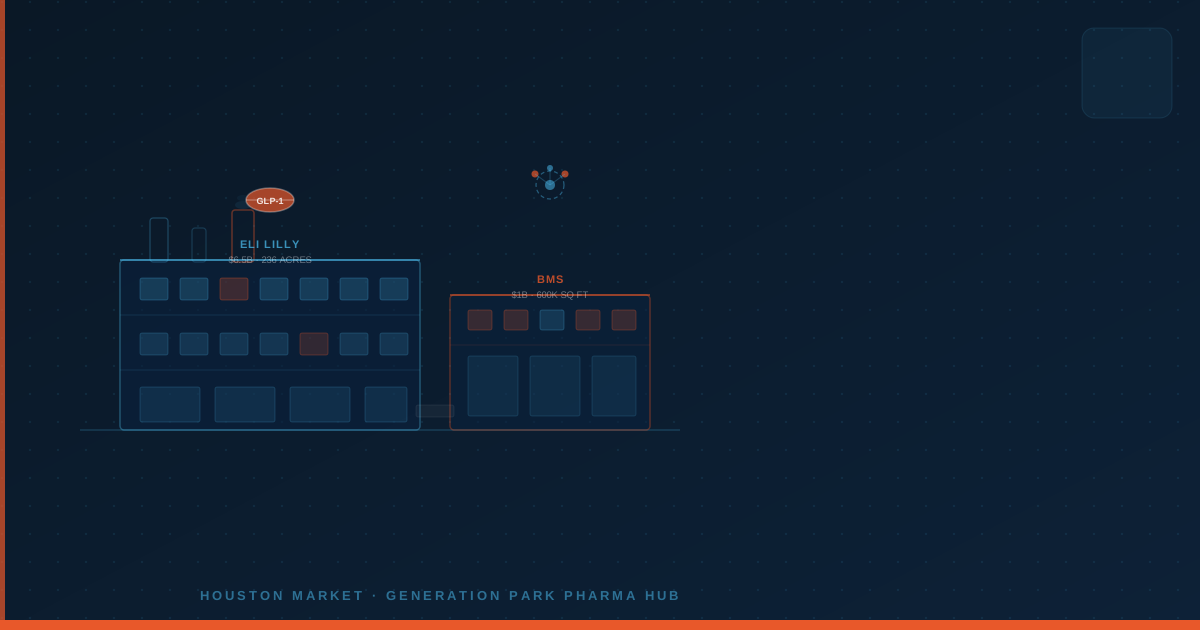
For decades, Houston built its industrial identity around oil and gas. But a new kind of infrastructure is taking shape in northeast Houston — one measured not in barrels, but in bioreactors, clean rooms, and cold chain corridors. Generation Park has quietly emerged as the pharmaceutical manufacturing hub that could reshape Houston's economic future.
Two of the world's largest pharmaceutical companies — Eli Lilly and Bristol Myers Squibb — are placing billion-dollar bets on this 4,000-acre master-planned development. The implications for Houston's logistics infrastructure, including temperature-controlled freight, are substantial.
The Eli Lilly Mega-Plant: $6.5 Billion and 236 Acres
Eli Lilly and Company
In one of the largest for-profit life science investments in Texas history, Eli Lilly is constructing a next-generation chemical synthesis facility designed to manufacture Active Pharmaceutical Ingredients (APIs). The plant is heavily engineered to mass-produce orforglipron — Lilly's highly anticipated first oral GLP-1 weight-loss and obesity medication — alongside other small-molecule therapies targeting oncology and immunology. The buildout is deeply reliant on advanced digital automation, AI-driven process controls, and robotics throughout the manufacturing chain.
Orforglipron is not just another drug. It is positioned as the first pill-form GLP-1 receptor agonist — a category that currently requires weekly injections (think Ozempic and Mounjaro). If it clears regulatory hurdles as anticipated, demand could dwarf anything the pharmaceutical industry has manufactured at scale before. Lilly chose Houston not by accident. The city offers the utility infrastructure, workforce pipeline, and logistical reach that a facility of this scale requires.
API manufacturing involves highly sensitive intermediates, biological materials, and finished drug substance that frequently require strict temperature controls during storage and transport. A plant of this scale generates constant outbound logistics demand — and that demand flows into Houston's reefer freight market.
Bristol Myers Squibb: The $1 Billion Neighbor
Bristol Myers Squibb (BMS)
Hot on the heels of Lilly, Bristol Myers Squibb filed applications for a massive 600,000-square-foot manufacturing plant, also located within Generation Park. The facility is designed to accommodate large-scale pharmaceutical formulation for both domestic and international drug markets, with significant room on-site for modular future expansion. Unlike Lilly's API synthesis focus, BMS's buildout targets finished drug product manufacturing — the last critical step before product moves into the cold chain.
BMS's presence is notable for a second reason: it signals that Generation Park is not a one-company story. When two Fortune 500 pharmaceutical manufacturers plant flags on the same campus within months of each other, it tends to attract suppliers, contract manufacturers, and logistics providers in a cascade effect. The cluster dynamic is already forming.
Why Generation Park? The Infrastructure Answer
Northeast Houston offers a convergence of factors that few locations in the country can match for heavy-duty pharmaceutical manufacturing:
What Makes Generation Park Viable for Pharma Manufacturing
- Utility infrastructure: The site can support the enormous power, water, and waste treatment demands of continuous pharmaceutical manufacturing — a capability constraint that eliminates most competing sites.
- Workforce pipeline: Houston's medical center complex, the largest in the world, feeds a deep talent pool of chemists, engineers, and regulated-environment technicians.
- Logistics connectivity: Port of Houston, two Class I rail connections, and Interstate highway access give Generation Park direct reach to national and international distribution.
- Regulatory readiness: Texas has invested in building a state-level support infrastructure for pharmaceutical manufacturing compliance — permits, environmental review, and workforce incentives.
- Land availability: At 4,000 acres with master-planned infrastructure, Generation Park has room for expansion in a way that most urban industrial sites do not.
What This Means for Houston's Cold Chain
Pharmaceutical manufacturing at this scale does not happen in isolation from logistics. Every step in the pharma supply chain — from raw material receipt to API movement to finished drug distribution — involves temperature-sensitive freight that must be handled within strict parameters.
The volume generated by two plants of this size is difficult to overstate. A single large pharmaceutical manufacturing facility can generate hundreds of temperature-controlled shipments per week during steady-state operations. At the API synthesis stage, chemical intermediates may require controlled temperature storage. Finished small-molecule drugs — tablets and capsules — often require temperature-controlled distribution to maintain stability. Biological raw materials and cell culture media require cold chain from supplier to facility.
Serving pharmaceutical clients at this level requires GDP-aligned operations, validated refrigerated equipment, continuous temperature monitoring with data logging, and documented chain-of-custody. This is not a drop-and-drive business. It is a compliance business. The carriers who invest in proper qualification now will be positioned to capture this freight as the plants ramp to production.
The Broader Signal for Houston's Economy
The Lilly and BMS investments are not standalone events — they are leading indicators of a broader shift in how Houston positions itself in the life sciences economy. Pharmaceutical manufacturing requires the same industrial discipline, engineering talent, and infrastructure capacity that built the petrochemical industry. Houston already has those assets. What it is building now is the regulatory credibility and life sciences ecosystem to complement them.
For businesses in Houston's logistics and transportation sector, the strategic read is clear: pharmaceutical freight is growing, it is high-value, it is compliance-intensive, and it is becoming a fixture of the Houston market rather than a specialty niche.
How Oryzon Cold Is Positioned
Oryzon Cold Transport was built from the ground up with pharmaceutical-grade cold chain standards in mind. Our refrigerated vehicles operate with continuous temperature monitoring and data logging. Our drivers are trained in GDP-aligned handling protocols. Our documentation practices are designed to withstand regulatory audit.
We are not chasing the pharmaceutical opportunity — we are built for it. As Generation Park's manufacturing footprint grows, so does the local demand for carriers who can meet the standard that pharmaceutical clients require. That is the business we are in, and that is the standard we hold ourselves to on every load.
Oryzon Cold's Pharmaceutical Cold Chain Capabilities
- Validated refrigerated box trucks with digital temperature monitoring
- Continuous temperature data logging — load-in to delivery confirmation
- Chain-of-custody documentation for every pharmaceutical shipment
- FSMA Sanitary Transportation Rule compliance across all loads
- GDP-aligned training for all drivers handling pharmaceutical freight
- Houston-based, same-day and next-day pharmaceutical delivery capability
Shipping Pharmaceutical Freight in Houston?
Talk to Oryzon Cold about what compliant pharmaceutical cold chain transport looks like — from API receipt to finished drug distribution.
Get a Pharmaceutical Quote →